
GST for Exporters: Avoid the Intermediary Trap
Discover the crucial insights every exporter must know about GST. Learn how the intermediary trap can affect your earnings in dollars while paying in rupees. Stay informed and safeguard your business!
Rhushikesh C Patil
12/11/20252 min read
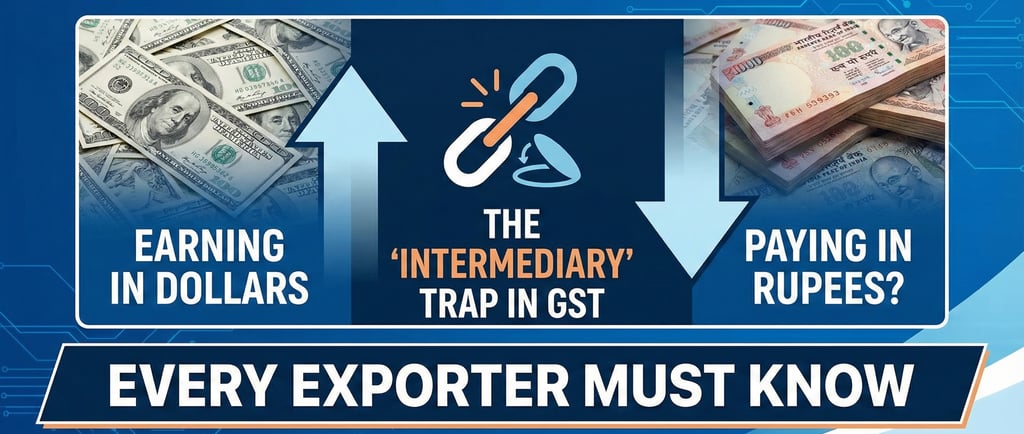
Earning in Dollars, Paying in Rupees? The "Intermediary" Trap in GST Every Exporter Must Know - By Rhushikesh C Patil, GST Practitioner
Imagine this: You provide high-value consultancy services to a client in the USA. You raise an invoice in USD, the money hits your bank account with a proper FIRC, and you file your GST returns as a "Zero-Rated Export" (paying no tax).
Two years later, you receive a notice from the GST Department demanding 18% tax + interest + penalty.
The reason? The officer claims you are not an Exporter, but an Intermediary.
This is one of the most litigated and confusing areas of GST law today. As exporters and service providers, understanding the "Intermediary Trap" (IGST Section 2(13)) is no longer optional—it is a survival skill.
The Myth: "Foreign Currency = Export"
Most businesses assume that if the money comes in convertible foreign exchange and the client is abroad, it is automatically an export. This is incorrect.
While receiving Forex is a condition for export status, the deciding factor is the Place of Supply (POS).
Normal Rule: If the client is abroad, the POS is abroad → Export (No Tax).
The Trap (Sec 13(8)(b)): If you are an "Intermediary," the POS shifts to your location (India) → Domestic Supply (18% Tax).
Who is an Intermediary?
Under Section 2(13) of the IGST Act, an intermediary is a broker, agent, or any person who "arranges or facilitates" a supply of goods or services between two other persons.
The "3-Party" Test: To be an intermediary, three parties must exist:
The Principal (Your Client)
The Third Party (The End Customer)
You (The Facilitator)
If your role is merely to connect Party A and Party B (like a commission agent or a broker), you are an intermediary. You are selling "facilitation," and since you are in India, the facilitation is taxed in India.
The "Safe Harbor": Principal-to-Principal
The confusion arises when Indian professionals (consultants, back-office support, marketing agencies) work for foreign clients who have their own customers.
Scenario: A US Web Agency hires you to design a logo for their client in the UK.
The Risk: The Tax Officer might say, "You are facilitating the service between the US Agency and the UK Client."
The Defense (Circular 159): Thankfully, the CBIC issued Circular No. 159/15/2021-GST, which provides a crucial shield. It clarifies that Sub-Contracting is NOT Intermediary Service.
If you provide the "Main Service" (e.g., you actually design the logo, write the code, or prepare the audit report) on your own account, you are a Principal, not an intermediary. Even if your output is eventually used by a third party, your contract is with your client on a Principal-to-Principal basis.
How to Protect Yourself: The Checklist
If you are exporting services, ensure your documentation passes the "Intermediary Test":
Check Your Agreement: Does your contract say you are "facilitating," "liaising," or "acting on behalf of"? Remove these words. Use terms like "Performance of Service," "Deliverables," and "Principal-to-Principal basis."
Fee Structure: Avoid commission-based models (% of deal closed). Fixed fees or hourly rates strongly indicate you are providing a direct service, not just brokering a deal.
Scope of Work: Be specific. Instead of "Marketing Support," write "Creation of Digital Marketing Assets and Campaign Management." Show that you are doing the work.
Conclusion
The line between an "Exporter" and an "Intermediary" is thin, but the financial difference is massive (0% vs 18%). Don't let a drafting error in your contract turn your tax-free export income into a heavy tax liability.
If you are unsure whether your current business model falls under the "Intermediary" trap, feel free to reach out for a detailed review of your agreements.